
Can Immigrants Open a U.S. Bank Account in 2026? SSN, ITIN and Nonresident Rules

Can Immigrants Open a U.S. Bank Account in 2026?
Yes. U.S. citizenship and a green card are not federal requirements for opening a bank account. Many immigrants can open checking or savings accounts with a passport, another accepted government ID, an address, and an identification number the institution can verify. A Social Security number makes the process easier, but it is not the only identification number allowed for a non-U.S. person under the federal bank customer-identification rule.
The important distinction is that federal rules establish a minimum identification framework, while each bank or credit union writes its own risk-based account-opening policy. A document accepted at one institution, branch, or application channel may be rejected at another.
Last verified: July 26, 2026. Account requirements change. Confirm the current document list with the specific institution before applying, especially if you do not have an SSN, do not live in the United States, or plan to open the account online.
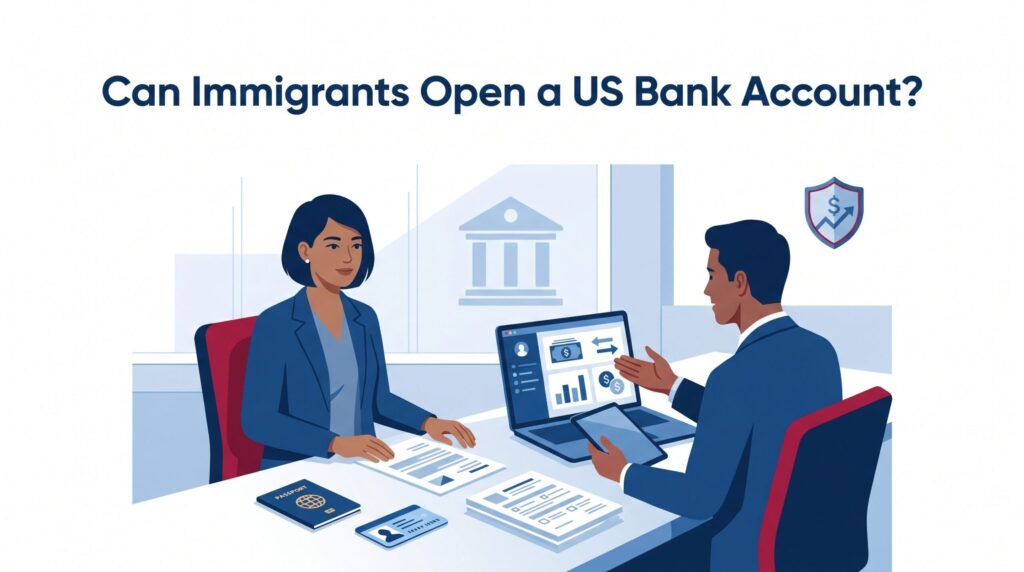
Bottom line: no federal rule says that every immigrant must show an SSN. However, a bank may still require an SSN, ITIN, U.S. address, in-person visit, or additional documents under its own policy.
Quick Answer by Immigration and Residency Situation
Your immigration category does not by itself decide whether you can have a deposit account. What matters in practice is whether the institution can verify your identity, address, tax status, and other information required by its compliance program.
| Situation | Account may be possible? | Documents commonly requested |
|---|---|---|
| Lawful permanent resident | Usually yes | SSN, government photo ID, address, contact details, and opening deposit if required |
| Work-authorized nonimmigrant | Usually yes | Passport, visa or immigration document, SSN if issued, address, and a second ID |
| International student or exchange visitor | Often yes | Passport, visa, I-20 or DS-2019, school ID, address, and SSN or ITIN if available |
| Immigrant without an SSN | Often, but not at every institution | Passport or accepted consular ID, ITIN if eligible and available, proof of address, and a second ID |
| Undocumented immigrant | Possible at institutions that accept alternative ID | Foreign passport or accepted consular ID, address evidence, ITIN if available, and other bank-specific documents |
| Nonresident or visitor living abroad | Possible but significantly harder | Passport, foreign address, tax certification, contact information, source-of-funds details, and often an in-person visit |
These are practical examples, not universal approval rules. A bank may request more information, decline a particular document, limit account types, or require a branch visit.
What Federal Bank Identification Rules Actually Require
Banks must maintain a Customer Identification Program, commonly called a CIP. The current federal rule requires the bank to collect a customer’s name, date of birth, address, and an identification number before opening most accounts.
For a non-U.S. person, the identification number may be a taxpayer identification number, a passport number with the country of issuance, an alien identification card number, or another government-issued identification number that evidences nationality or residence and includes a photograph or similar safeguard. You can read the exact rule in 31 CFR § 1020.220.
The same rule requires banks to use documentary or non-documentary methods to verify identity. It specifically recognizes that opening an account without appearing in person can create additional verification risk. That is one reason an online application may fail even when a branch could review the same foreign passport successfully.
Federal Minimum vs. the Bank’s Own Policy
| Question | Federal framework | What a bank may do |
|---|---|---|
| Is an SSN always mandatory? | No for a non-U.S. person; other identification numbers are listed in the CIP rule | Require an SSN for a particular product or online application |
| Is a foreign passport allowed? | It is one recognized identification option | Accept only certain passports, require a second ID, or require an in-person review |
| Is a U.S. residential address always required? | The CIP rule requires an address and contains alternatives for a person without a residential or business street address | Require a U.S. residential or mailing address under the institution’s product policy |
| Does presenting the documents guarantee approval? | No | Decline after identity, fraud, sanctions, account-history, or other risk checks |
This distinction prevents two common mistakes: believing that an SSN is always legally mandatory, or believing that a bank must open the account merely because a passport is permitted by federal regulation. Neither statement is accurate.
Documents to Prepare Before Applying
Prepare original, current documents whenever possible. Names, dates of birth, addresses, and identification numbers should match across the application. A spelling difference, abbreviated surname, old address, or expired passport can trigger a manual review.
1. Primary Government-Issued Photo ID
- Unexpired foreign or U.S. passport;
- State driver’s license or state identification card;
- Permanent resident card or employment authorization document;
- Foreign national identification card, when accepted; or
- Consular identification card, such as a matrícula consular, when accepted by the institution.
The Consumer Financial Protection Bureau’s account-opening checklist notes that some banks and credit unions accept foreign passports and consular IDs. It also emphasizes that each institution decides which foreign documents it accepts.
2. Second Form of Identification
- A second photo ID;
- Social Security card or ITIN assignment notice;
- Birth certificate;
- Student identification card;
- Visa, Form I-20, Form DS-2019, Form I-94, or another immigration document requested by the institution; or
- A debit or credit card from another financial institution, if the bank accepts it as secondary identification.
3. Address Evidence
- Lease or rental agreement;
- Utility, mobile phone, or internet bill;
- Government or school correspondence;
- Insurance statement;
- Employer record or pay statement; or
- Another recent document showing the same name and address used on the application.
A mailing address is not always the same as the residential address the institution must collect. Do not use an address where you do not actually live or receive authorized mail. Ask the bank how it handles a temporary residence, campus housing, a host family, or a customer whose permanent home is abroad.
4. Identification or Tax Number
- SSN, if you are eligible and it has been issued;
- ITIN, if you are eligible for one for a federal tax purpose;
- Foreign passport number and country of issuance;
- Alien identification card number; or
- Another accepted government-issued identification number.
5. Contact, Funding, and Tax Information
- U.S. or international phone number and email address;
- Opening deposit, if the account requires one;
- Employment, occupation, and expected account-activity information;
- Source-of-funds information for larger or unusual deposits; and
- Form W-9, Form W-8BEN, or another tax certification when requested.
Can You Open a U.S. Bank Account Without an SSN?
Yes, it may be possible. The CFPB states that a person does not necessarily need an SSN to obtain a bank or credit union account, and the federal CIP rule lists alternative identification numbers for non-U.S. persons. In practice, your options depend on the institution and application channel.
If an online form makes the SSN field mandatory, do not enter a fake number or use another person’s number. Call the bank and ask whether it has a branch-based process for customers with a passport, ITIN, alien identification number, or other foreign ID. A failed automated application does not prove that every account at that institution is unavailable.
Ask precise questions: Which account types can be opened without an SSN? Is an ITIN required? Is a foreign passport accepted? Which proof of address works? Must you apply in person? Will the account pay interest? The answer may differ between checking, savings, and credit products.
Can You Use an ITIN to Open a Bank Account?
Many institutions accept an Individual Taxpayer Identification Number, but an ITIN is not a universal substitute for an SSN. The bank may still require photo identification, address verification, a second document, and other compliance information.
An ITIN is a federal tax-processing number. The IRS makes an important limitation clear: an ITIN does not establish immigration status, authorize employment, or create eligibility for Social Security benefits. The IRS also does not issue an ITIN solely to open a bank or investment account. Applicants must have a qualifying federal tax purpose and follow the current Form W-7 rules. See IRS Topic No. 857 before assuming you can obtain an ITIN only for banking.
If you already have an ITIN, verify that the name on the IRS notice matches your bank application. An expired ITIN may still cause problems for tax reporting even when a bank has previously used the number for identity records.
Can Undocumented Immigrants Open Bank Accounts?
Potentially, yes. Federal customer-identification rules do not make lawful immigration status a universal condition for a deposit account. An institution may be able to identify a customer through a foreign passport, consular ID, ITIN, or another accepted document.
That does not mean every bank offers this process, and it does not make an account approval automatic. The bank may ask for additional documents or decline if it cannot complete identity verification. Opening an account does not regularize immigration status, provide work authorization, or replace legal advice about a person’s immigration situation.
Use your real name, real address, and genuine documents. Never borrow an SSN, alter a document, or claim a tax status that is not yours. False information can lead to account closure and may create legal consequences far more serious than an application denial.
Can a Nonresident or Tourist Open an Account From Abroad?
A nonresident can sometimes open a U.S. account, but this is usually the hardest situation. The federal rule permits identification through a foreign passport or other qualifying number, yet the institution may require an in-person visit, a U.S. address, a U.S. phone number, a tax form, or evidence explaining the purpose and expected use of the account.
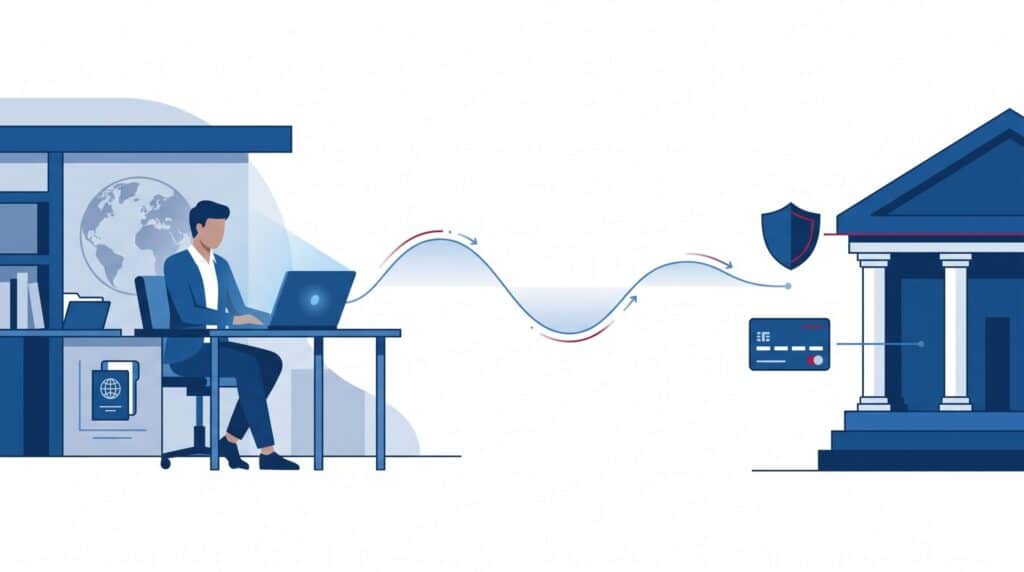
Remote onboarding is not simply the branch process moved online. Banks must address the higher identity-verification risk of a customer who does not appear in person. Some institutions restrict online applications to people with an SSN and a verifiable U.S. address even when a branch has more flexible document procedures.
A tourist should not assume that a hotel, mailbox service, registered agent, friend, or relative’s address satisfies the bank’s residential-address policy. Explain your actual residence and ask what documentation is accepted. If an institution cannot serve a customer living abroad, choose another lawful option rather than misrepresenting residence.
Bank Accounts for International Students and Exchange Visitors
F-1 students, J-1 exchange visitors, and other temporary visa holders can often open accounts after arriving in the United States. Campus-area branches may be familiar with foreign passports, Form I-20, Form DS-2019, Form I-94, school IDs, and temporary addresses.
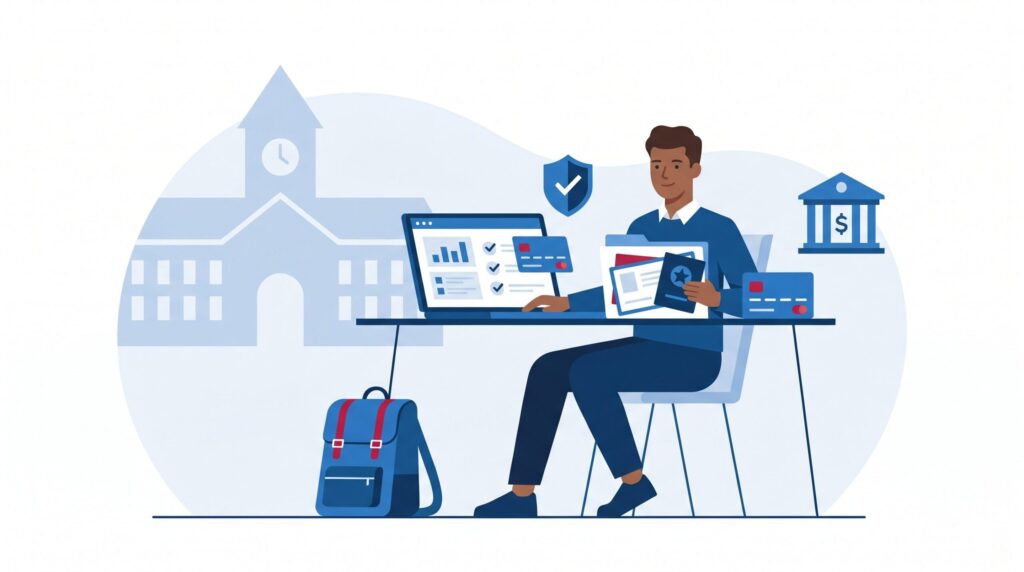
Bring your passport, visa documentation, school record, local address evidence, and SSN or ITIN if one has been issued. If you have just arrived and lack a utility bill, ask whether the bank accepts a university housing letter, lease, enrollment document, or official school correspondence.
A student who is not eligible for an SSN should not apply for one merely because a bank employee requests it. Ask for the institution’s alternative-identification process. An SSN is generally tied to Social Security eligibility rules, while an ITIN requires a federal tax purpose.
Bank, Credit Union, or Fintech App: Which Is Safer?
| Provider | Main advantage | What to verify |
|---|---|---|
| FDIC-insured bank | Direct deposit relationship with an insured bank | BankFind listing, fees, accepted identification, branch access, and insurance ownership category |
| Federally insured credit union | Potentially lower fees and local service | Membership eligibility, accepted identification, and NCUA insurance status |
| Nonbank fintech or money app | Convenient onboarding and transfers | Identity of the partner bank, how funds are titled and recorded, access during an outage, and limits of pass-through insurance |
A familiar app interface does not necessarily mean the company is a bank. The FDIC warns that its insurance protects against the failure of an insured bank, not the insolvency or bankruptcy of a nonbank company. When a fintech places customer money at a partner bank, pass-through coverage depends on the arrangement and accurate account records.
Before depositing money, identify the legal bank holding the funds and verify it through the FDIC BankFind Suite. For a credit union, verify federal insurance and membership terms. The NCUA explains federal share-insurance coverage for eligible accounts at federally insured credit unions.
Does FDIC Insurance Cover Immigrants and Nonresidents?
Yes, citizenship or U.S. residence is not required for FDIC protection. At an FDIC-insured bank, the standard maximum deposit-insurance amount is $250,000 per depositor, per insured bank, for each account ownership category. The limit applies to the depositor’s combined balances in the same ownership category at the same bank, not separately to every checking or savings account.
The FDIC’s Your Insured Deposits guide explains the coverage categories and limits. Federally insured credit unions generally provide similar federal share insurance through the NCUA. Deposit insurance does not cover investment losses, cryptocurrency, stocks, bonds, or the failure of a nonbank platform.
Tax Forms: W-9, W-8BEN, and Interest Income
Bank identification status, immigration status, and federal tax residency are related but not identical. Do not choose a tax form only from the visa label printed in your passport.
- U.S. citizens and resident aliens for federal tax purposes: the bank will generally request Form W-9 and a taxpayer identification number.
- Nonresident alien individuals: the bank may request Form W-8BEN to document foreign status.
- When tax residency changes: notify the institution and provide the correct updated certification.
The IRS specifically instructs nonresident aliens not to give Form W-9 to a U.S. bank merely for deposit interest; they generally provide Form W-8BEN instead. See the IRS guidance on bank interest for nonresident aliens. Tax treaties, residence tests, account ownership, and other income can change the result, so obtain individualized tax advice when the classification is uncertain.
How to Open the Account: A Practical Step-by-Step Plan
- Choose the account type. Decide whether you need checking, savings, or both. A personal account should not be used as a substitute for a business account.
- Shortlist insured institutions. Verify FDIC or NCUA coverage and compare branches, ATM access, transfer options, and customer support.
- Call before applying. Describe your exact situation without sending documents by unsecured email: no SSN, ITIN holder, foreign passport, student, nonresident, or another profile.
- Request the current document list. Ask whether the rules differ online and in a branch.
- Make the information consistent. Use the same legal name, birth date, address, and identification details across every document.
- Apply through the appropriate channel. If automated verification cannot process foreign documents, schedule an in-person appointment.
- Review tax certification carefully. Submit W-9, W-8BEN, or another form only when it matches your actual tax status.
- Read the fee schedule before funding. Check monthly maintenance fees, minimum-balance rules, overdraft terms, ATM charges, wire fees, and foreign-transaction costs.
- Keep records. Save the deposit agreement, fee schedule, account-opening disclosures, confirmation, and contact information.
Why an Application May Be Denied
- The institution cannot verify the identity or address through its systems;
- A required document is expired, damaged, inconsistent, or not accepted under that bank’s policy;
- The online process requires an SSN even though another application channel may not;
- The applicant’s name or date of birth does not match external records;
- The bank cannot serve the applicant’s country, location, or expected activity under its risk policy;
- A checking-account consumer report contains prior unpaid overdrafts, suspected fraud, or inaccurate information;
- Sanctions, anti-money-laundering, or identity-theft screening requires more review; or
- The account type is unavailable to a nonresident or customer without a particular tax certification.
If a bank used a checking-account consumer report in its decision, ask which reporting company supplied the information and request your report. The CFPB maintains information on companies such as ChexSystems and explains the right to dispute inaccurate or incomplete data. Correcting an error may help, but a bank can still apply its lawful account-opening policy.
How to Compare Accounts Without Being Distracted by a Bonus
A sign-up bonus is rarely the most important feature for a newcomer. First confirm that the institution accepts your documents and that you can keep the account open affordably after any promotion ends.
- Monthly maintenance fee and realistic ways to waive it;
- Minimum opening deposit and minimum balance;
- Overdraft and nonsufficient-funds policies;
- ATM network and out-of-network fees;
- Cash-deposit access;
- Domestic and international wire fees;
- Foreign card and currency-conversion fees;
- ACH transfer limits and hold periods;
- Mobile check-deposit eligibility;
- Multilingual support and branch availability; and
- Direct FDIC or NCUA insurance rather than a vague claim that funds are merely “eligible.”
The CFPB’s bank-account resources include guidance on overdraft, deposit holds, account denials, and questions to ask before opening an account.
Personal Accounts Are Not Business Accounts
A personal checking account is designed for personal income and expenses. If you operate an LLC, corporation, or other business, the bank will usually request entity documents, an Employer Identification Number when required, beneficial-owner information, and details about the company’s activity. A business account also helps separate company transactions from personal funds.
Forming an entity does not guarantee that a bank will open an account for a foreign owner. The bank must still verify the business and the people behind it. If you are considering a U.S. company, read our guide to starting an LLC in the USA, then confirm the bank’s requirements before paying for formation services.
Frequently Asked Questions
Can an immigrant open a U.S. bank account without a green card?
Yes. A green card is not a universal federal requirement for a deposit account. Approval depends on whether the institution can verify the applicant and accepts the documents presented.
Can I open a U.S. bank account without an SSN?
Possibly. Federal rules list alternative identification numbers for non-U.S. persons, including a passport number and country of issuance. Individual banks may still require an SSN for certain products or online applications.
Can I use an ITIN instead of an SSN?
Many institutions accept an ITIN, but not all do. An ITIN is issued for federal tax purposes, does not authorize employment, and is not issued solely to open a bank account.
Can an undocumented immigrant open a bank account?
Potentially. Some institutions accept foreign passports, consular IDs, ITINs, or other alternative documents. Opening an account does not create lawful immigration status or work authorization.
Can a tourist open a U.S. bank account?
Sometimes, but it can be difficult. A bank may require an in-person visit, address evidence, tax certification, and a documented reason for the account. Policies vary by institution.
Can I open a U.S. bank account remotely from another country?
Some providers support remote onboarding, but many bank applications require an SSN, U.S. address, or in-person identity review. Never misrepresent your residence to pass an online form.
What proof of address can an immigrant use?
Common examples include a lease, utility bill, government or school correspondence, insurance statement, or employer record. The institution decides which documents and how recent they must be.
Can an international student open an account without an SSN?
Often yes, depending on the institution. A branch may accept a passport, visa documents, I-20 or DS-2019, school ID, local address evidence, and an ITIN if available.
Are noncitizens covered by FDIC insurance?
Yes. Citizenship and U.S. residence are not required for FDIC deposit insurance. The standard limit is $250,000 per depositor, per insured bank, for each ownership category.
Is money in a fintech app automatically FDIC-insured?
No. A nonbank app is not itself FDIC-insured. Funds may qualify for pass-through coverage at a partner bank only if the arrangement and account records meet applicable requirements, and FDIC insurance does not protect against the nonbank’s failure.
Does a checking account build U.S. credit?
Usually not by itself. Checking activity is generally not reported like a credit card or loan. Negative account history may still be reported to checking-account screening companies.
What should I do if my bank-account application is denied?
Ask what requirement was not met and whether another application channel accepts your documents. If a checking-account consumer report was used, request the report and dispute inaccurate information.
Final Checklist Before You Apply
- The institution is FDIC-insured or the credit union is federally insured by the NCUA;
- You know whether the provider is a bank, credit union, or nonbank fintech;
- The institution confirmed which foreign IDs, SSN alternatives, and address documents it accepts;
- Your name, date of birth, and address are consistent across all records;
- You understand whether W-9, W-8BEN, or another tax form applies;
- You know the monthly fee, minimum balance, overdraft rules, ATM costs, and transfer fees;
- You have not used a false SSN, false address, or altered document; and
- You have saved the account agreement and current fee schedule.
For many immigrants, opening a U.S. bank account is achievable even without citizenship or a green card. The most effective approach is not to search for a supposed loophole. It is to choose an insured institution, disclose your real circumstances, bring consistent identification, and use a bank whose written policy supports your profile.
This article provides general educational information and is not individualized immigration, legal, banking, or tax advice.